IP 101: What are the different types of Intellectual Property?
by Kacper Gorski - Head of GTM of Lighthouse IP
A simple reference for builders, counsel, and leadership. Jurisdictions vary; this is general information, not legal advice.
Patents (utility)
A patent is an exclusive right over a technical invention: how something works or is made. Scope is set by the claims after examination; terms are typically 20 years from filing, with fees due to keep it alive. File before any public disclosure or you risk losing novelty.
Best at protecting: core, copyable technical functionality (e.g., a new drug mechanism or a manufacturing method).
Design rights (industrial designs / US design patents)
Design rights protect the product’s look; shape, lines, contours, patterns, or colours, rather than function. In the US, design patents run 15 years from grant; in the EU, registered designs can last up to 25 years (unregistered designs protect for 3 years). File close to launch to preserve “newness.”
Best at protecting: distinctive product appearance and UI iconography that influence buying decisions.
Trademarks
A trademark is any sign that distinguishes your goods or services: names, logos, slogans, trade dress. Rights are territorial and class‑based, renewable indefinitely if used and maintained. Always do clearance before you commit to a name.
Best at protecting: brand identity and channel control for products and services.
Copyright
Copyright covers original expression: software code, text, images, music, video, documentation. Protection is automatic on creation in most countries, though registration can strengthen remedies in some places. It guards expression, not ideas or functions.
Best at protecting: codebases, content libraries, manuals, artwork, and UX copy.
Trade secrets
Trade secrets protect valuable, non‑public information that has commercial value because it is secret. Protection lasts as long as secrecy and “reasonable measures” (NDAs, access controls, logging) are maintained. One leak can end the right.
Best at protecting: formulas, algorithms, data pipelines, pricing logic; know‑how you don’t want to disclose.
Utility models (where offered)
Utility models, often called “short‑term patents” can protect technical inventions via a lighter system in some countries. Terms are shorter (commonly 7–10 years) and procedures faster/cheaper, with narrower scope and easier invalidation.
Best at protecting: incremental mechanical or electrical improvements where speed and cost matter.
PCT international phase (filing route, not a right)
The Patent Cooperation Treaty lets you file one “international” application to defer country choices (usually to month 30/31) and receive a search/written opinion. It preserves options; it does not grant a patent.
Best at protecting: your option value while you validate markets and funding before expensive national filings.
Supplementary Protection Certificates (SPCs) / patent term extensions
SPCs extend patent protection for authorised medicines and plant protection products to offset regulatory delay (commonly up to 5 years, plus pediatric extensions in some cases). Rules are technical and jurisdiction‑specific.
Best at protecting: time‑to‑market value in pharma and agrochem after long approvals.
Plant variety rights (PVRs)
Under UPOV‑style systems, breeders obtain exclusive rights in new, distinct, uniform, and stable plant varieties. Authorisation is needed to produce/market propagating material; terms are often 20–25 years, longer for trees/vines.
Best at protecting: the commercial variety itself (e.g., new crop cultivars and fruit trees).
Semiconductor topographies (mask works)
These rights protect the three‑dimensional layout of integrated circuits. Protection is typically sui generis with shorter terms (often ~10 years) and may arise by registration or first commercial use.
Best at protecting: specific chip layer layouts against direct copying.
EU sui generis database right
Separate from copyright, the EU grants a property right for databases where there has been “substantial investment” in obtaining, verifying, or presenting contents. The right lasts 15 years and can renew with substantial updates.
Best at protecting: curated, costly‑to‑compile datasets and indices (especially where creativity is limited).
Geographical indications (GIs)
GIs are signs for products with qualities or reputation essentially attributable to a place protected via GI/PDO/PGI systems (EU) or certification marks (US). They can endure indefinitely with compliance and controls. E.g. Champagne or Parmigiano Reggiano.
Best at protecting: origin‑linked quality/reputation in food, wine/spirits, and regional specialties.
Domains and social handles (adjacent but critical)
Not an IP right, yet essential identifiers aligned with trademarks. Register early, renew on time, and use UDRP or local policies for disputes.
Best at protecting: discoverability and brand surface area that complements trademarks.
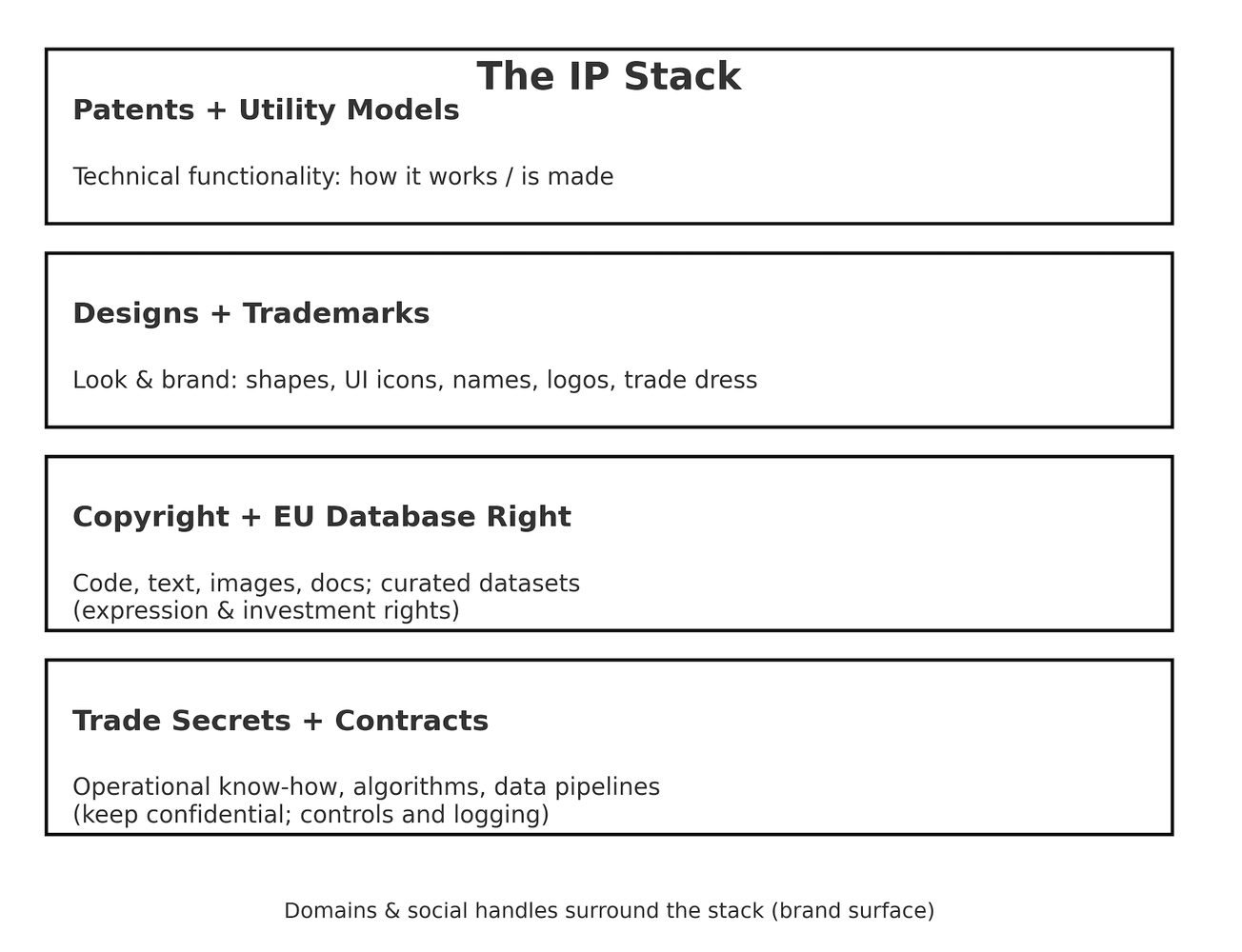
Choosing quickly

About the author Kacper Gorski - Head of GTM of Lighthouse IP
Kacper Gorski is Head of Go to Market at Lighthouse IP, where he leads commercial strategy and partnerships for the company’s global patent, trademark, and design data. He focuses on turning complex IP information into practical tools and services, working with law firms, corporates, and analytics partners to link IP data to real business decisions. Kacper is currently developing new AI and vector based services that make IP data more accessible and actionable for customers.