OCR to NLP: Art or Sience?
by Willem Geert Lagemaat
CCO - Lighthouse IPMost teams stop at “we extracted the text.” That is not the finish line. In IP workflows, the value starts after OCR, when you recover structure, identify entities with confidence, and make the data safe for decisions.
The messy reality
IP PDFs are inconsistent. Scans vary by office and era. Layouts can shift mid-document. Mixed scripts and ligatures confuse naive tokenization. A single O/0 swap can break a publication link. Tables, claims and legal-status sections need structure recovery, not just text. Treat everything as plain paragraphs and you lose the signals your downstream systems rely on.
A quick example
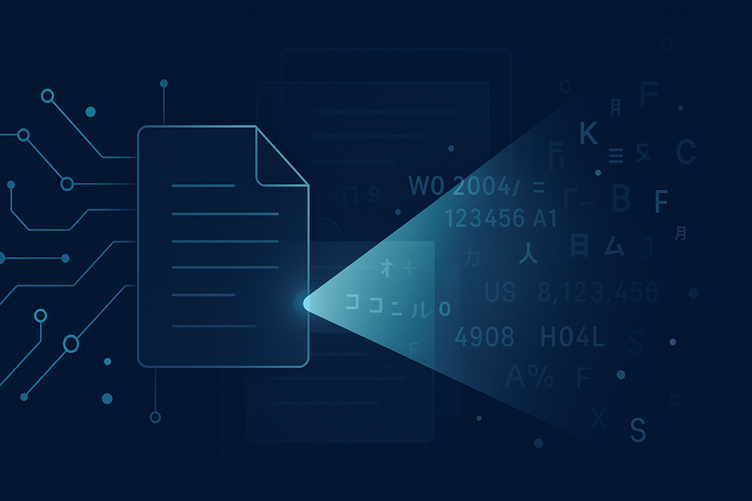
Office-action PDFs often mix Latin and Cyrillic. Publication numbers like “WO 2004/123456 A1” sometimes lose separators during OCR and normalization, so nothing matches downstream. The fix is straightforward: use script-aware OCR, apply jurisdiction-specific number patterns, and restore expected separators in post-processing. Result: resolvable identifiers and clean joins instead of duplicate records.
The five moves that turn OCR into decisions
- Pre-process and segment pages so the OCR engine sees clean, de-skewed content and correct regions.
- Choose OCR modes by script and layout, not one size fits all.
- Add domain-aware NLP: lexicons and patterns for identifiers, section and table recovery, assignee normalization.
- Keep a human in the loop for the hardest slice only, and feed every correction back as rules or training data.
- Run it like production: services and queues, versioned models, drift and confidence monitoring, and dashboards that track cost, latency and failure by jurisdiction.
Where things typically break
- Identifiers fail pattern checks and silently drop from joins.
- Mixed scripts trigger the wrong OCR mode and wreck recall.
- Line-wrap artefacts and hyphenation split entities across tokens.
- Multi-column gazettes flatten into paragraph soup and lose structure.
- No confidence routing means reviewers waste time on easy pages instead of the risky ones.
Measure what matters
Character accuracy is not your KPI. Linkability is: can you resolve entities and join records end to end. Rework avoided matters: how many manual minutes you save per 1,000 pages. Latency matters: time from ingest to decision-ready data. Stability matters: low, predictable failure rates across offices, languages and layout classes. If you cannot measure it, you cannot improve it.
Closing thought
OCR gets you text. Domain-aware NLP turns text into signals. The teams that win treat this as an engineered system with guardrails, feedback and accountability.

About the author Willem Geert Lagemaat - Founder and CCO of Lighthouse IP
In 2006 Willem founded Lighthouse IP, the leading global IP information provider. The company since then has expanded worldwide and has created a unique collection of patent-, trademark- and business related data.